
Zohram Kwame Mamdani would be the city's first Muslim and Indian American mayor if elected New York mayor this November.

Union Finance Minister Nirmala Sitharaman, along with her team of bureaucrats, delved into the fine print of the 2024-25 Budget documents in a press conference, detailing the government's road map on bringing down the debt-to-GDP ratio and bold tax measures.

'The adjustments (of tax slabs and standard deduction) will reduce the tax burden for salaried individuals with an income of around Rs 20 lakh by approximately Rs 18,000.' 'For non-salaried individuals with the same income level, the savings will be around Rs 10,000.'

Doubling standard deduction to Rs 1 lakh, increasing tax break on interest paid on housing loan and rationalisation of capital gains tax regime are some of the expectations that consultancy firm KPMG has from the Budget 2024-25 to be unveiled on July 23 in Parliament. There has been a significant rise in medical expenses, fuel costs and overall inflation.

Trump made it clear he had no plans to speak with Musk anytime soon, stating, "I'm too busy doing other things," and added, "I have no intention of speaking to him," NBC News reported.

'Government's focus should be on the expenditure side in this Budget, not so much on the taxation side.'

Widening of the tax base, doing away with cess and surcharge, improvement in compliance and moderation in tax for emerging sectors are some of the suggestions submitted to the Finance Ministry ahead of the Budget by Think Change Forum (TCF). Experts are of the opinion that there is a need to grow tax revenues for the government to drive economic growth and make investments in developmental activities, TCF, the think tank said in a statement. Towards this end, poor compliance was identified as a weak link in achieving targeted collections leading to complex issues like overtaxing, complicated tax structures, rising litigation, among others.

'I don't know how long cinema will survive.'

In her Budget speech, Finance Minister Nirmala Sitharaman on Tuesday underlined the need for collaboration between the Centre and states to take up the next-generation reforms covering land, labour, capital and entrepreneurship. As far as revenue share goes, the government has projected to give about 32.5 per cent of central taxes to states during FY25, against the 15th Finance Commission's recommendation of 41 per cent, according to the Union Budget estimate.

Finance Minister Nirmala Sitharaman is likely to hold pre-budget consultations with industry chambers on June 20, sources said. The budget for 2024-25 fiscal is likely to be presented in Parliament in the second half of July. Industry sources said the pre-budget consultation with Sitharaman would be preceded by a meeting with Revenue Secretary Sanjay Malhotra on June 18.

All eyes will be on whether Sitharaman will deliver a populist budget leaving more money in hands of the common man or push the reform agenda by staying on the fiscal glide path to lower the fiscal deficit to 4.5 per cent of GDP by 2025-26.

The interest rate on these schemes have remained unchanged for over a year now.

The Budget announcement of zero tax for earnings upto Rs 12 lakh per annum and the rejig of tax slabs across the board should prompt more than 90 per cent of individual taxpayers to embrace the new tax regime as compared to the about 75 per cent as of now, CBDT Chairman Ravi Agrawal said. Agrawal also highlighted the government's focus on "non-intrusive" tax administration through enhanced use of Artificial Intelligence (AI) and simplified tax processes for common taxpayers. He emphasized the benefits of the new tax regime (NTR), which offers simple calculations and allows taxpayers to file their ITR without professional help. The CBDT chief stated that the Budget provisions related to income tax payment benefit all income earners, not just those earning Rs 12 lakh per annum, creating a positive sentiment in the economy and propelling growth. The department is also harnessing technology, including AI and data analytics, to widen and deepen the tax base, resulting in increased compliance and tax revenue. Agrawal further highlighted the positive impact of data availability and simplified tax processes on compliance rates, citing examples of taxpayers filing revised returns and paying taxes after being prompted by the department's data analysis.

'Volumes in F&O trading had gone up rapidly and, in a way, the increase in STT on F&O will protect investor interest.'

High spectrum costs limit operators to invest in next-gen network infrastructure.
After a gap of three years, direct tax collections -- which include corporate tax and personal income tax -- have exceeded the Budget estimates for FY'22, indicating economic recovery.

The Opposition on Tuesday termed the Union Budget as a 'kursi bachao budget' driven by political compulsions and claimed that it ignored opposition-ruled states in a bid to 'appease' Bharatiya Janata Party's allies.

Anticipating US action on tariffs, India seems to have made the first move by revamping its tariff structure by reducing the slabs to eight rates, points out Mukesh Butani.

Opposition MPs in India's Rajya Sabha raised concerns about US President Donald Trump's tariff threats, demanding the government clarify its response and engage in discussions with opposition parties. Leaders like P Chidambaram and Sagarika Ghose warned of potential economic repercussions, including depressed exports, lower FDI, and a significant tariff burden. The debate also touched on other issues such as the government's economic policies, demonetization, and the impact of GST on common citizens.

The Budget proposed abolishing the under-performing, authority of advance ruling, to replace it with a two-member board of advance ruling.

The International Monetary Fund (IMF) has slapped 11 new conditions on Pakistan for the release of the next tranche of its bailout programme and warned that tensions with India could heighten risks to the scheme's fiscal, external, and reform goals, according to a media report on Sunday.

Reminiscent of the past two years, the market has made positive strides ahead of the Union Budget 2023-24 (FY24). The benchmark National Stock Exchange Nifty has gained 1.8 per cent in the last month. Typically, markets tend to gain ahead of the Budget as investors build in optimism.

'Going forward, the encouragement would be to move to the new tax regime.'
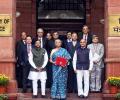
Finance Minister Nirmala Sitharaman on Thursday presented her sixth Budget in a row, equalling the record of former Prime Minister Morarji Desai.

RBI's interest rate decision, quarterly earnings and global cues would be the major driving factors for equity markets this week, analysts said adding that the impact of the Union Budget could linger on this week. Trading activity of foreign investors will also be a key driver for the markets, experts noted. "US and India's manufacturing PMI for January to be released on Monday, will be the key macro data to watch out for.

An Income-Tax Department internal committee reviewing the old direct tax law to pave the way for a new one has "largely" received suggestions for "simplifying" the language, better "structuring" the provisions and enlarging the ambit of schemes like presumptive taxation, CBDT chairman Ravi Agrawal said Sunday. Speaking to PTI during a post-Budget interview at his North Block office, Agrawal said the panel also "studied" the deliberations and processes of countries like the UK, Australia and some others where a similar tax law simplification exercise was undertaken.

Ask rediffGURU and PF expert Milind Vadjikar your insurance, stocks, mutual fund and personal finance-related questions.

During 2023, the Indian real estate sector - both housing and commercial - witnessed buoyancy fuelled by demand, supply, and absorption, and the sector is banking on the upcoming Budget to keep the momentum going. Mumbai-based Sattva Group wants the government to focus on the critical pillars for long-term growth. The company emphasised on the infrastructure boom with increased allocation, lower goods and services tax (GST) rates, incentives for affordable housing and single-window clearance to fast-track projects and support liquidity.

'We have now drastically simplified it, primarily to two rates in long-term capital gains: 20% and the applicable rates. Similarly, in short-term capital gains.' 'For listed shares, there is a slight increase, but for unlisted shares, where indexation benefits are removed, there is a reduction in rates, benefiting unlisted companies, venture capital firms, etc.' 'Similarly, in real estate, wherever returns are higher, the new structure is beneficial. In very few cases, returns are lower, and those are more of an exception.'

'We need to be very vigilant as we are passing through some fraught times.'

Continuing our series on how to achieve Financial Independence and Retire Rarly (FIRE), Vatsal Ramaiya emphasises the importance of planning for retirement.

In today's dynamic economic landscape, commerce and management education is crucial for a global career, says Nayagam PP.

Uttar Pradesh, Gujarat and Odisha budgets maintain revenue surpluses despite welfare schemes while Rajasthan and West Bengal face high debt, fiscal deficits and low capital outlay.
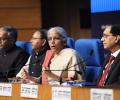
Finance Minister Nirmala Sitharaman on Friday proposed to double the limit for Tax Deduction at Source (TDS) on interest income for senior citizens to Rs 1 lakh, and also increase the threshold to Rs 6 lakh on rent from the current Rs 2.4 lakh.

Finance Minister Nirmala Sitharaman will have to do a tight-rope walk between staying fiscally prudent and general public expectations of lower taxes and a wider social security net, while at the same time firing the engines of the economy before general elections. Sitharaman will on Wednesday present her fifth straight Budget at a time when the economy is slowing due to global headwinds and specific sectors need attention. In the run-up to the Budget presentation, expectations are rife that she may tweak income-tax slabs to provide relief to the middle class and increase spending on the poor through programmes such as the rural job scheme while ramping up financial incentives for local manufacturing.

This is important because he is to be seen as a sure winner before criss-crossing the state to campaign for candidates of the party or an alliance, highlights N Sathiya Moorthy.

Direct tax collection, net of refunds, moderately exceeded the revised estimates (RE) for the financial year 2023-24 (FY24) on the back of personal income tax revenues, but corporation tax receipts fell short of the RE. Net direct tax collection stood at Rs 19.58 trillion in FY24, surpassing the RE of Rs 19.45 trillion by Rs 13,000 crore, or 0.7 per cent. The government had revised up FY24 projections for personal income tax by 13.5 per cent over the Budget estimates (BE) of Rs 9 trillion, at Rs 10.22 trillion.

Finance Minister Nirmala Sitharaman on Tuesday said buyback of shares will be taxed in the hands of shareholders similar to dividend from October 1, a move that will increase the tax burden on investors. Further, the cost paid by the shareholder to acquire these shares will be considered for computation of capital gains or loss to them.

Data since 2005 show that the five years with the highest rainfall saw average market returns of 8.98 per cent, while the five driest years returned 25.7 per cent on average.

The government's capital expenditure in the April-November period of financial year 2024-25 (FY25) continued to contract with a 12.3 per cent decline year-on-year (Y-o-Y), according to data released by the Controller General of Accounts on Tuesday.
 © 2026 Rediff.com - Advertise with us - Disclaimer - Privacy Policy - Sitemap - Feedback - About us - Terms of use - Grievances